
Evenimente
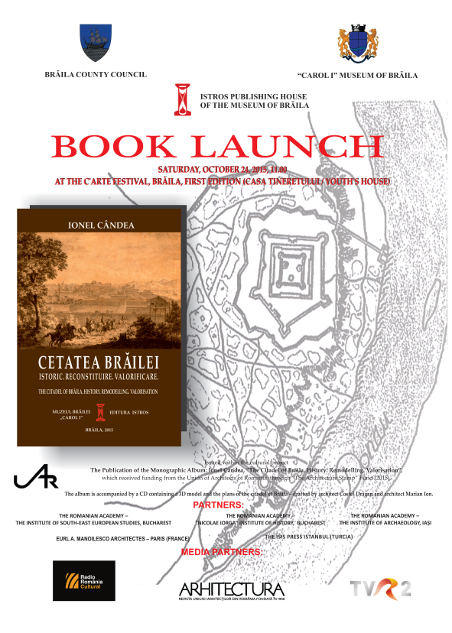
The launch of the album IONEL CÂNDEA, “THE CITADEL OF BRĂILA. HISTORY. REMODELLING. VALORISATION" (bilingual Romanian / English) - issued within the cultural project which received funding from the Union of Architects of Romania, through “THE ARCHITECTURE STAMP” FUND (2015) – at THE C’ARTE FESTIVAL
PRESS RELEASE
The “Carol I” Museum of Brăila invites you to the launch of the album Ionel Cândea, “The Citadel of Brăila. History. Remodelling. Valorisation" (bilingual Romanian / English), which will take place on Saturday, 24 October 2015, 11,00, during the first edition of C’Arte festival, organised during the period 21 – 24 October 2015 at the Youth’s House (54 Calea Calăraşilor, Foyer, Second floor) by the Brăila County Council and the APLER Association of the Literary Publications and Publishing Houses of Romania, in partnership with “Panait Istrati” County Council.
Presentations: architect PhD Costel Drăgan – chief architect of Brăila County, architect Marian Ion – chief architect of the city of Brăila and professor PhD Ionel Cândea – manager of “Carol I” Museum of Brăila.
The album is accompanied by a CD containing the plans and a 3D model of the citadel – the authors of this part are: architect PhD Costel Drăgan and architect Marian Ion – and it is issued within the cultural project The Publication of the Monographic Album: Ionel Cândea, “The Citadel of Brăila. History. Remodelling. Valorisation”, which received funding from the Union of Architects of Romania, through “The Architecture Stamp” Fund (2015).
The album will also be launched, in early November 2015, at Bucharest – at the Cultural Centre of the Union of Architects of Romania (Monday, 2 November 2015, 16,00), at Cetatea Făgăraş (Thursday, 5 November 2015, 11,00) and at Romexpo, during the International Tourism Fair (which will take place during the period 12-15 November 2015 – the exact date and time will be announced at a later date).
***
Other information about the cultural project titled The Publication of the Monographic Album: Ionel Cândea, "The Citadel of Brăila. History. Remodelling. Valorisation" (bilingual Romanian / English):
The period of implementation: March – 18 December 2015.
Funding: 23,000 lei from the Union of Architects of Romania, through “The Architecture Stamp” Fund.
The project was proposed and drafted by: Camelia Hristian, museographer – chief of the Financial – Accounting and Public Relations Department of “Carol I” Museum of Brăila, and Professor PhD Ionel Cândea, manager of “Carol I” Museum of Brăila.
Project manager: Professor PhD Ionel Cândea, manager of “Carol I” Museum of Brăila.
Partners: The Romanian Academy – ”Nicolae Iorga” Institute of History, Bucharest; The Romanian Academy – The Institute of South-East European Studies, Bucharest; The Romanian Academy – The Institute of Archaeology, Iași; Eurl A. Manoilesco Architectes – Paris (France); The Isis Press Istanbul (Turkey).
Project team: Professor PhD Ionel Cândea – project manager, author and cover design; architect PhD Costel Drăgan – scientific consultant; architect Marian Ion – scientific consultant; Associate Professor PhD Constantin Ardeleanu – coordination of the English version; Camelia Hristian – designing project, PR officer and reader; Rozalia Pîrlitu – copy editor and DTP; Mariana Vernescu – financial supervisor.
Media partner: "Arhitectura" Revue of the Union of Architects of Romania, Radio Romania Cultural and TVR2.
***
This work aimed, on three large sections, to remodel the largest and most important Ottoman stronghold on the left bank of the Lower Danube, the Citadel of Brăila, from a historical perspective, but also regarding its architectural evolution from its foundation (its construction was started by the Turks in October 1840) until its demolition in 1830-1831; this is extremely interesting as a part of the vestiges that belonged to the citadel are under the current level of the modern city.
After annexing Brăila in 1538, Suleiman the Lawgiver ordered the erection of a fortress; it was started in 1540, but was not completed in 1546. Its emplacement and initial aspect, as well as subsequent historical events, caused the citadel to suffer changes that we tried to identify, stage by stage. Documentary sources referred to the three sieges it was subjected to during the 16th century, i.e. that of Ioan Vodă cel Cumplit (May 1574) and those in which Michael the Brave attacked the citadel twice, by means of Banul Mantu – in 1594 and 1595, managing to set it free for a short time. When they returned to the citadel, the Ottomans restored it and fortified its previously destroyed walls. A fact that needed to be clarified, i.e. that if the citadel had from its beginnings in the 16th century a fortification for the civil settlement, as it results from several accounts of these events. In the 17th century the citadel was struck hard in 1659 by Mihnea III, the hospodar of Wallachia, who burned it, according to Miron Costin’s account, when he started his insurrection against the Turks. Since the 18th century the citadel was developed, meaning the construction of a wall with a ditch and a palisade which surrounded the civil settlement. We analysed if these works meant a new structure or if they only restored and developed past realities. A strong blow was received in 1810, a century after the siege of 1711, that is to be “read” in the differences existing between the Austrian plan of 1790 and the Ottoman one of 1819, the last known appearance of the citadel before the demolition ordered by the Russians. The remodelling of the citadel is supported by archival sources found at BOA Istanbul – the Ottoman Archives subordinated to the Presidency of the Council of Ministers of the Republic of Turkey (T.C. Bașbakanlɩk Osmanlɩ Arșivi) –, documents that have been and continue to be found by researchers, just as the archaeological investigations reveal important aspects concerning the issues raised by such an attempt.
Another part of the paper identified the vestiges that remained from the Citadel of Brăila, among which a special place belongs to the New Gunpowder Mill and the catacombs with a military character. The restoration of some of them represents an important challenge for the municipality and the inhabitants of Brăila. We shall try to identify those spots from the area of the former citadel where it is possible to reconstruct parts of the lost elements, for example of the bastions, at least at their last appearance, that from two centuries ago (1819). For this, we are supported by a recent and important discovery from the southern area of the last fortifications: an access way towards and from the last bastion of the fortification (wall – palisade – ditch) with good chances of being restored and valorised. The valorisation means a program that will cover the restoration of several vestiges that remained from the citadel (The New Gunpowder Mill, the Postern, Wall IV – wall and ditch with a palisade; access – entrance – exit to the southernmost bastion) and then its touristic valorisation.
The CD included: 1. Historical plans; 2. The citadel – catacombs – the new gunpowder magazine; 3. Overlaying the citadel onto Brăila’s current plan; 4.1. Model plan – 1790; 4.2. Model plan – 1819; 4.3. Model plan – remodelling; 5. Route for visiting sites in Brăila; 6. Laser markers; 7. Display board.
The work is a distress signal, the basis of future projects, a scientific instrument and a tool of promoting the most fascinating touristic brand of Brăila.
For more information:
Professor PhD Ionel Cândea, manager of “Carol I” Museum of Brăila, project manager 0339.40.10.02, 0339.40.10.03
PRESS RELEASE - PDF format
Camelia Hristian
Museographer – chief of the Financial – Accounting and Public Relations Department
"Carol I" Museum of Brăila
www.MuzeulBrailei.ro
http://diversitate-culturala-muzeulbrailei.ro/
Facebook: Muzeul Brailei “Carol I”
Te pot interesa
-
Lansarea albumului IONEL CÂNDEA, „CETATEA BRĂILEI. ISTORIC. RECONSTITUIRE. VALORIFICARE" (bilingv română / engleză) - apărut în cadrul proiectului cultural beneficiar al unei finanţări din partea Uni...
-
Lansarea cărţii “MANUSCRISUL PIERDUT” de VALENTIN POPA, – apărută la Editura “Istros” a Muzeului Brăilei “Carol I” - la FESTIVALUL DE C’ARTE BRĂILA, ediţia I


